
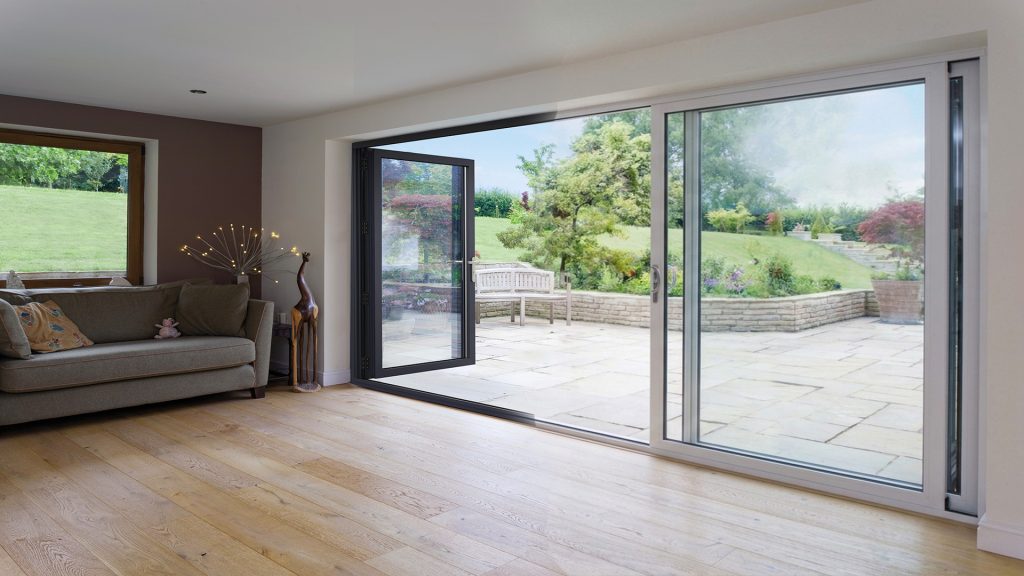
Bifold or Sliding Doors: Which Should You Choose?
If you’re planning a home extension, renovation or simply want to replace an old set of patio doors, you’ve probably come across two popular options: aluminium bifold doors and aluminium sliding doors.
Both can transform a room by bringing in more natural light and creating a much better connection between your home and garden. But they work in quite different ways.
So, which should you choose — bifold or sliding doors?
The answer depends on what matters most to you: how much of the opening you want to open, the view you want when the doors are closed, how you use the room and the overall appearance you prefer.
What is the difference between bifold and sliding doors?
The simplest way to explain the difference is how the doors open.
Bifold doors
Bifold doors are made up of several individual panels which are connected by hinges.
When you open them, the panels fold and stack together at one or both sides of the opening.
This means you can open up a large proportion of the overall aperture, creating a wide opening between your home and garden.
For example, a four-panel bifold door can typically fold the panels together towards one side, while larger configurations can be designed to open from the centre or stack in different arrangements.
Sliding doors
Sliding doors use large glass panels which slide horizontally behind or alongside one another.
Rather than folding, the panels remain flat and move along tracks.
This allows manufacturers to create very large glazed areas, with relatively few vertical sections interrupting the view.
The result can be a spectacular wall of glass with excellent views of the garden even when the doors are closed.
Bifold vs sliding doors: at a glance
| Aluminium bifold doors | Aluminium sliding doors | |
|---|---|---|
| How they open | Panels fold and stack | Panels slide past each other |
| Opening available | Very large opening | Usually around 50% of the aperture |
| View when closed | More vertical sections | Large uninterrupted areas of glass |
| Connection to garden | Excellent | Excellent |
| Sightlines | More vertical lines | Fewer vertical lines |
| Glass panels | Generally smaller | Can be very large |
| Best suited to | Maximising the opening | Maximising the view |
| Appearance | More architectural/folding | Minimal and contemporary |
| Threshold options | Available | Available |
| Configurations | Very flexible | Very flexible |
The table gives you the basic difference, but there are several other things worth considering.
1. How much of the opening do you want to open?
This is probably the biggest difference between the two.
If your priority is to open up as much of the wall as possible, bifold doors have an advantage.
The panels fold away and stack at the side, potentially leaving most of the opening clear.
This can be particularly useful when you regularly entertain or when your kitchen, dining area and garden are designed to work as one space.
Sliding doors work differently.
Because the panels have to slide behind or alongside one another, part of the opening will normally remain covered by glass when the doors are open.
However, this isn’t necessarily a disadvantage.
For many homes, having 50% of a large opening open is more than enough.
And when the doors are closed, the large glass panels provide a fantastic view of the garden.
2. Which gives you the better view?
If the view is your priority, sliding doors are worth serious consideration.
Because sliding systems can use large panes of glass with relatively few vertical sections, they can create an almost uninterrupted picture of the garden.
This can be particularly effective if your property overlooks a garden, countryside or another attractive view.
Bifold doors have more vertical lines because each opening panel has its own frame.
When they’re open, those panels fold away.
But when they’re closed, you’ll see more aluminium across the width of the opening.
So there is a simple way of thinking about it:
Bifolds are about opening the wall.
Sliders are about looking through the wall.
Neither approach is necessarily better — they simply create a different experience.
3. How do they look?
This is ultimately a matter of personal preference.
Aluminium bifold doors have a distinctive architectural appearance. The multiple panels and folding mechanism can make a large opening feel more dynamic.
Sliding doors tend to have a more minimalist appearance, particularly when using slim aluminium profiles.
The larger glass panels can give a contemporary property a clean, uncluttered appearance.
If you’re replacing doors in a traditional property, the choice may also depend on the architecture of the building.
A good installer should be able to show you examples of both options so you can see how they look in a similar type of property.
4. Are sliding doors more expensive than bifolds?
There isn’t a simple answer.
The cost depends on the size of the opening, the number and size of panels, the aluminium system, glass specification, colour, threshold, hardware and installation requirements.
Large-format sliding doors can require substantial panes of glass, which can affect the overall cost.
Likewise, a large bifold configuration with multiple panels, specialist hardware and a complicated opening can also become expensive.
So rather than assuming that one type is always cheaper, it’s better to compare like-for-like specifications.
When comparing quotations, check that you’re comparing the same:
- Door size
- Aluminium system
- Glass specification
- Number of panels
- Colour and finish
- Threshold
- Handles and hardware
- Installation
- Building work
- Any structural alterations
A cheaper quotation isn’t necessarily comparing the same product.
5. What about thermal performance?
Modern aluminium doors can provide excellent thermal performance.
The fact that the frame is made from aluminium doesn’t mean that the door will necessarily be cold.
Quality aluminium systems use thermally broken frames, together with modern double or triple glazing, to help reduce heat transfer through the frame.
When comparing doors, look at the actual performance specifications rather than simply comparing “bifold” against “sliding”.
Factors such as the glass, frame, seals and installation all contribute to the finished performance.
6. Which is better for entertaining?
If you regularly have friends and family around and want to create a large opening onto a patio or garden, bifold doors can be particularly appealing.
Opening several panels together can create a genuine indoor-outdoor feel.
Imagine a summer barbecue where the kitchen opens almost completely onto the patio.
However, sliding doors can work extremely well too.
A large sliding opening gives you a substantial connection to the garden while retaining a clean wall of glass.
If you don’t need the entire opening to disappear, sliding doors may actually be the better fit.
7. What about the size of the opening?
The size and shape of your opening should be considered before deciding which type of door you want.
Very wide openings can work extremely well with both systems, but the design possibilities are different.
Sliding doors can accommodate very large individual glass panels, creating impressive expanses of glass.
Bifold doors divide the opening into more sections because of their folding configuration.
This is why it’s worth discussing the project with an aluminium door specialist before deciding on the exact configuration.
Sometimes the building itself will influence the best solution.
8. Which is easier to use?
Both systems are designed to be easy to operate when correctly specified and installed.
Bifold doors rely on hinges, rollers and folding hardware.
Sliding doors use rollers and tracks.
With either system, correct installation and adjustment are important.
A large aluminium door should feel smooth and controlled when operated. If a door is difficult to open or close, it is worth having it checked rather than simply accepting that this is how large doors work.
Regular cleaning of tracks, seals and moving parts can also help keep the doors operating properly.
So, bifold or sliding doors?
There isn’t one answer that is right for every home.
Instead, think about what you want the doors to achieve.
Choose bifold doors if:
- You want to open up as much of the wall as possible.
- You want the panels to fold and stack away.
- You regularly entertain and want a strong connection between the house and garden.
- You like the distinctive appearance of multiple folding panels.
- Creating a large physical opening is more important to you than having the fewest vertical sightlines.
Consider sliding doors if:
- Your priority is the view when the doors are closed.
- You want large areas of uninterrupted glass.
- You prefer a minimalist, contemporary appearance.
- You don’t need the entire opening to open.
- You want to create a dramatic glazed wall overlooking the garden.
What if you’re still undecided?
This is where looking at the doors in person can make a big difference.
Photographs don’t always show you the difference between a bifold and sliding door properly.
Seeing the frame profiles, opening mechanisms, sightlines and glass sizes in person can make it much easier to decide which style suits your home.
At Aluminium Projects, we supply aluminium bifold and sliding doors for homes and projects across Dronfield, Sheffield, Chesterfield, North Derbyshire and South Yorkshire.
We’re based on Callywhite Lane in Dronfield, so if you’re planning a project and aren’t sure whether bifold or sliding doors would work best, get in touch and we can talk through the options.
Bifold or sliding: the simple answer
If you want the largest possible opening, start by looking at bifold doors.
If you want the largest possible view, start by looking at sliding doors.
But don’t make the decision based on that alone.
The size of the opening, the architecture of your property, your budget, how you use the room and the appearance you want should all be considered.
And sometimes the best solution isn’t obvious until you’ve looked at the actual opening and considered how you want to use it.
Planning a project? Talk to Aluminium Projects about your options for aluminium bifold and sliding doors.